
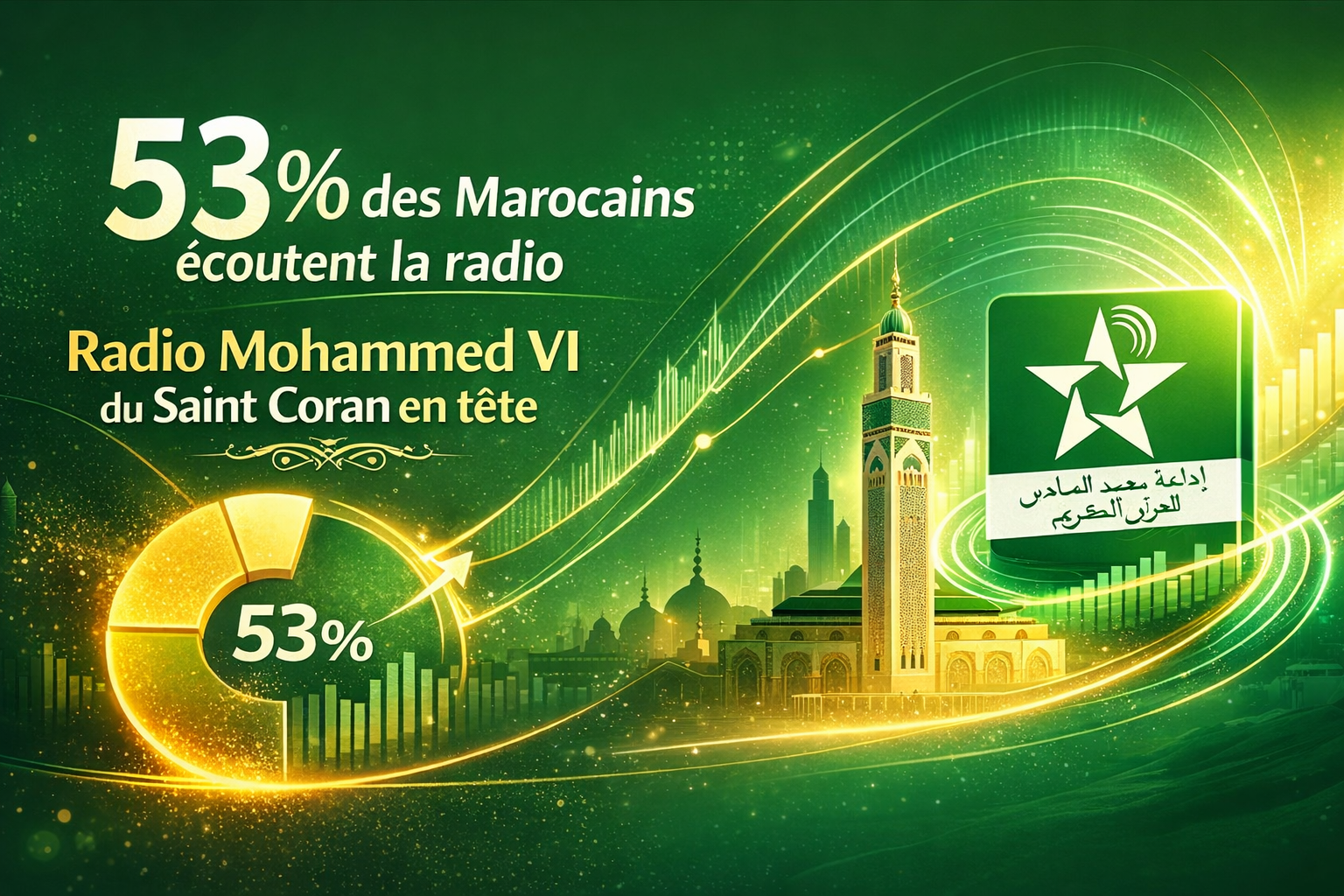

The Moroccan radio landscape is in remarkably good health. According to a recent national study, 53% of Moroccans aged 15 and over declare that they listen to the radio regularly. This figure, far from being trivial, confirms the vitality of a medium that some observers thought was in decline in the face of the rise of digital platforms.
An audience rate that defies forecasts
While music streaming applications and podcasts are gaining ground all over the world, traditional radio maintains a solid audience in Morocco. With more than one in two Moroccans listening regularly, the radio medium continues to play a central role in the cultural and informational habits of the country.
This high penetration rate is explained by several converging factors: the immediate accessibility of the medium (in the car, at home, on mobile phones), the remarkable diversity of programming, and above all, the deep attachment of Moroccans to a radio that has accompanied their daily lives for several generations.
Radio Mohammed VI of the Holy Quran: Morocco's number one station
If the overall results are encouraging for the entire sector, Radio Mohammed VI of the Holy Quran stands out clearly as the most listened-to station in Morocco. This radio station, entirely dedicated to recitation, teaching and deepening knowledge of the Quran, benefits from a faithful and diverse audience that reaches all age groups, all social categories and all regions of the Kingdom.
Its prominence is not a matter of chance. In a country where Islam is constitutionally the religion of the State and where religious practice occupies a central place in the daily lives of millions of citizens, a radio station entirely devoted to the Holy Quran responds to a deep, constant and widely shared demand. Programmes of recitation, tafsir (Quranic exegesis), tajwid and Islamic education attract millions of listeners throughout the Kingdom, from the Moroccan Sahara to the mountains of the Rif and the Atlas.
Why radio remains indispensable in Morocco
Several fundamental reasons explain the remarkable resilience of radio in the Moroccan media landscape:
- Mobility: Radio remains the medium par excellence for travel. With a continuously growing vehicle fleet and often long commuting times in major cities, the car radio remains an indispensable companion for millions of Moroccans.
- Universal accessibility: Unlike digital platforms that require a stable internet connection and a subscription, FM radio remains accessible everywhere and free of charge, including in areas with low network coverage.
- Community ties: Radio creates social bonds. Live programmes, listener calls, current affairs debates and programmes in Moroccan dialect (darija) or the Amazigh language reinforce the sense of belonging and national community.
- Local roots: Moroccan radio stations offer programming deeply rooted in local reality, featuring Moroccan music of all genres, national and regional news, and cultural programmes that reflect and celebrate the country's identity.
The Moroccan radio landscape in figures
Morocco today has a plural, dynamic and constantly evolving radio sector, comprising around forty active stations. It includes historic public radio stations such as the National Radio (Al Idaa Al Watania), Radio Chaîne Inter, Radio Amazigh, Radio Assadissa and Radio Mohammed VI of the Holy Quran, alongside an abundant private offering: Hit Radio, Medi 1, MFM Radio, Atlantic Radio, Radio Mars, Chada FM, Cap Radio and Radio Aswat.
This diversity of offering constitutes one of the major assets of the Moroccan radio sector. Listeners can today choose between varied musical formats (international pop, rap, Oriental music, chaabi, gnawa, jazz), news and political debate stations, religious and spiritual stations, and regional stations that promote local cultures, languages and dialects.
The digital revolution: an accelerator for Moroccan radio
Far from being an existential threat, digital technology has gradually revealed itself to be a tremendous growth opportunity for Moroccan radio stations. Thanks to online streaming, Moroccan stations now reach a global diaspora of several million people. A Moroccan living in France, Belgium, Spain, Canada or Saudi Arabia can listen to Radio Mohammed VI of the Holy Quran, Hit Radio or MFM Radio live and in high quality, at any time, from any connected device.
Aggregator platforms such as Radios.ma play a structuring role in this digital transition, by grouping all Moroccan radio stations in a single portal accessible from any web browser or mobile application. This aggregation of supply considerably simplifies access and amplifies the global audience of all the Kingdom's radio stations, offering increased visibility to small regional stations as well as large national ones.
The sector's challenges for the coming years
The figures from this study carry a fundamentally optimistic message for all sector players. Radio is not a medium of the past — it is reinventing itself with strength and creativity. The challenges nevertheless remain very real and call for appropriate responses: the head-on competition from music platforms (Spotify, Deezer, Apple Music), the accelerated emergence of native podcasts, and the profound transformation of cultural consumption habits among younger generations impose constant adaptation and continuous self-questioning on stations.
To remain competitive towards 2030, Moroccan radio stations will need to invest heavily in the quality and originality of content, develop catch-up and podcast offerings with high added value, significantly strengthen their presence on social networks, and explore new interactive formats that reinforce engagement within their listener communities.
Tomorrow's radio will be multi-platform, hybrid and personalised, but its deep essence — that direct, warm and immediate connection with the listener — will remain its main and irreplaceable strength in the face of all new entrants.
In the meantime, the 53% of Moroccans who switch on their radio every day are the most eloquent testimony to the lasting vitality of a medium that has managed to traverse the decades without losing either its soul or its audience.